On this page
- Regulatory status first
- Evidence category map
- Who this is for
- What the evidence can support
- What remains uncertain
- Verification steps
- Risks, red flags, and limits
- Sources
- Evidence and status are separate questions
- Continue the evidence path
- Five independent quality questions
- Four results, four different questions
- Claim-linked evidence notes
Purity Is Not Sterility: Peptide Testing Explained
A testing-method map that prevents a common and potentially dangerous category error.1
Regulatory status first
A high chemical-purity result does not establish that an injectable product is sterile, free of endotoxin, correctly filled, stable, or manufactured under appropriate controls.1
Evidence category map
Who this is for
Women navigating midlife health decisions and the clinicians or reviewers helping them evaluate evidence and uncertainty.
What the evidence can support
- Validated methods can answer specific analytical questions.1
- Manufacturing controls and release testing work together.
- Batch traceability supports investigation when a problem occurs.
What remains uncertain
- One test cannot answer every quality question.1
- Sampling and chain of custody may be opaque.1
- Storage and shipping can affect a product after testing.1
Verification steps
- Ask which test answered which question.
- Look for method, laboratory, sample, date, and acceptance criteria.
- Treat missing sterility/endotoxin information as missing—not implied.
Risks, red flags, and limits
Sources
Evidence and status are separate questions
| Layer | Question | Common category error |
|---|---|---|
| Product status | Is the exact product approved, compounded, investigational or sold for research? | Treating a facility, ingredient or trial as product approval |
| Human evidence | Do trials match the molecule, route, population and claimed outcome? | Generalizing from animals, another peptide or another route |
| Quality | What identity, batch, sterility and endotoxin evidence exists? | Using analytical purity as a synonym for sterile or safe |
| Personal decision | What established alternatives, risks and monitoring questions matter? | Letting an online claim replace qualified care |
This publication provides no dose, cycle, injection technique, seller ranking or procurement path for unapproved investigational products.1
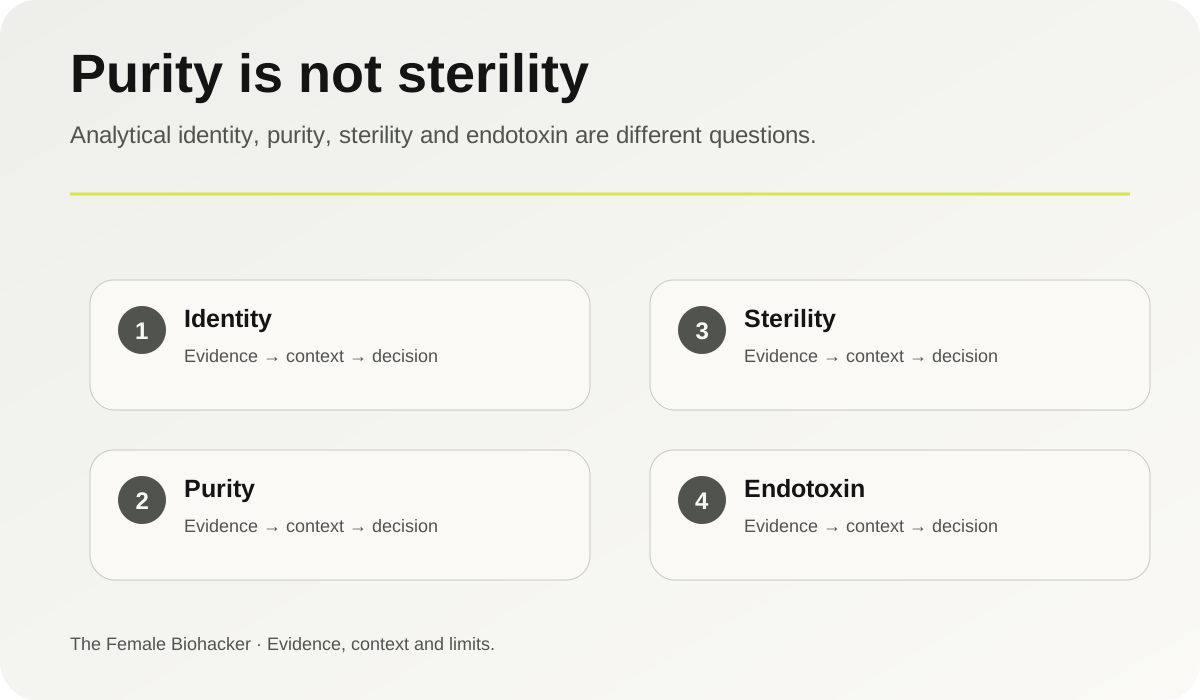
Five independent quality questions
Identity, amount, chemical purity, sterility and endotoxin are different questions.1 Stability, container closure, transport and handling add more. One HPLC percentage cannot answer the full set.1
Four results, four different questions
| Result | Question answered | Not established |
|---|---|---|
| Identity | Does the sample contain the target analyte? | Correct amount or absence of hazards |
| Purity/related substances | What proportion of detected analytical material matches the target under the method? | Sterility, endotoxin, potency in use or safety |
| Sterility | Did the sample meet the named compendial microbial test conditions? | Endotoxin, identity, content or future handling integrity |
| Endotoxin | Is bacterial endotoxin below the stated limit for that test? | Sterility or suitability of an unapproved product |
These distinctions matter most when a product is represented for injection. A purity number—however high—cannot be converted into “sterile,” “pharmaceutical grade,” or “safe to inject.”1
Claim-linked evidence notes
Read the linked sources in context: a source’s population, outcome and limitations determine where it applies. Its inclusion does not imply endorsement of this publication or prove an individual result.