On this page
- Regulatory status first
- Evidence category map
- Who this is for
- What the evidence can support
- What remains uncertain
- Verification steps
- Risks, red flags, and limits
- Sources
- Evidence and status are separate questions
- Evidence used on this page
- Continue the evidence path
- COA field-to-question matrix
- Keep identity, quality and vendor transparency separate
- What each field can—and cannot—support
How to Read a Peptide Certificate of Analysis
A field-by-field guide to what a COA may show, what it cannot show, and how verification can fail.1
Regulatory status first
A certificate of analysis is a test report for a stated sample and method.1 It does not automatically prove product identity across every vial, sterility, safety, lawful marketing, or suitability for human use.2
Evidence category map
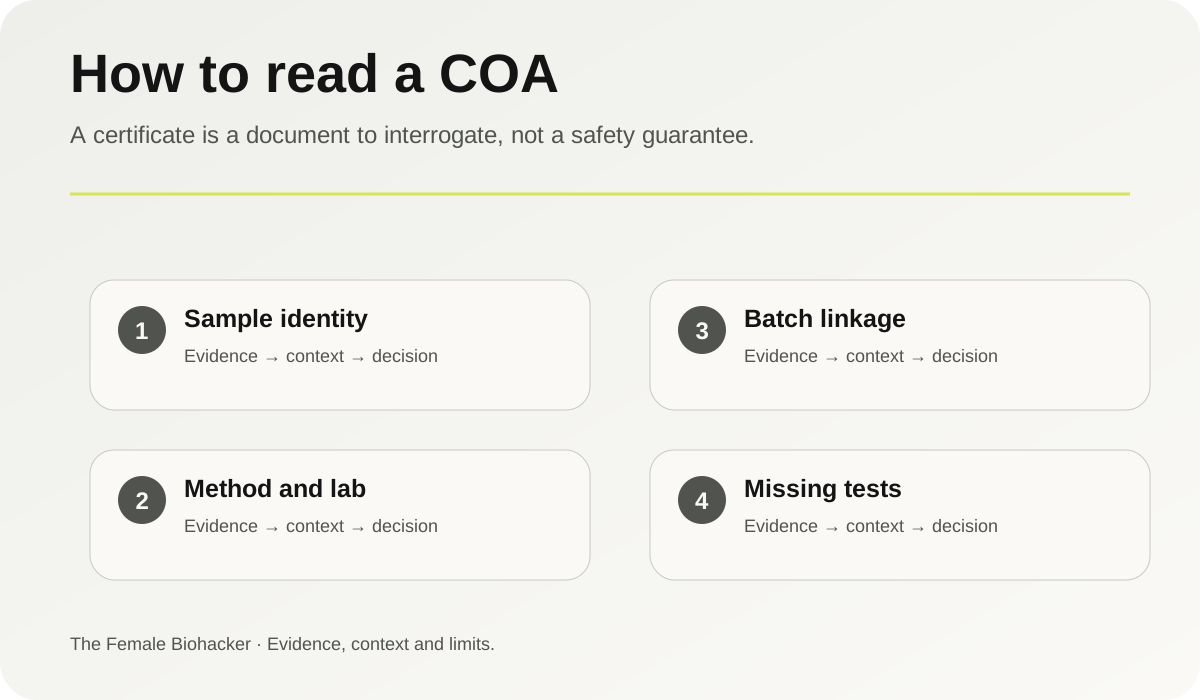
- Match batch/sample ID, dates, methods, and laboratory identity.
- Purity percentage is not the same as correct identity or sterile manufacture.1
- Independent verification and chain of custody matter.
Who this is for
Women navigating midlife health decisions and the clinicians or reviewers helping them evaluate evidence and uncertainty.
What the evidence can support
- Chromatography can describe purity under a stated method.1
- Mass spectrometry can support identity when appropriately conducted.1
- Sterility and endotoxin require separate validated testing.1
What remains uncertain
- The submitted sample may not represent shipped inventory.1
- A PDF can be altered or reused.1
- Accreditation scope may not cover the relevant method.1
Verification steps
- Verify the report with the named laboratory when possible.
- Compare report identifiers with the specific batch.
- Record missing fields rather than filling gaps with assumptions.
Risks, red flags, and limits
Sources
Evidence and status are separate questions
| Layer | Question | Common category error |
|---|---|---|
| Product status | Is the exact product approved, compounded, investigational or sold for research? | Treating a facility, ingredient or trial as product approval |
| Human evidence | Do trials match the molecule, route, population and claimed outcome? | Generalizing from animals, another peptide or another route |
| Quality | What identity, batch, sterility and endotoxin evidence exists? | Using analytical purity as a synonym for sterile or safe |
| Personal decision | What established alternatives, risks and monitoring questions matter? | Letting an online claim replace qualified care |
This publication provides no dose, cycle, injection technique, seller ranking or procurement path for unapproved investigational products.12
Claim-level source ledger
Evidence used on this page
- Current Good Manufacturing Practice (CGMP) Regulations | FDA. Checked 2026-08-25.
- Certain Bulk Drug Substances for Use in Compounding that May Present Significant Safety Risks | FDA. Checked 2026-08-25.
Interpretation boundary: each source is listed for the statement it supports; population and design limits remain visible.
COA field-to-question matrix
| Visible field | Question it may help answer | What it cannot establish alone |
|---|---|---|
| Sample/batch identifier | Can the report be tied to a named sample? | Chain of custody or future batches. |
| Method and chromatogram | Was a named analytical approach reported? | Sterility, endotoxin, fill accuracy or clinical suitability. |
| Laboratory identity/accreditation scope | Is the organization and relevant scope verifiable? | That the seller submitted the same vial offered to a buyer. |
| Date and report status | Is the document current and final? | Stability after the reported test date. |
Method limit: this desk framework has not authenticated any vendor document or tested a sample.
Keep identity, quality and vendor transparency separate
What each field can—and cannot—support
| Field | Useful check | Unanswered risk |
|---|---|---|
| Sample and batch ID | Matches the vial/lot and chain of records | Whether the submitted sample represented all units |
| Method and analyte | Names the instrument/procedure and target | Whether the method was validated for this matrix |
| Identity result | Supports that the target analyte was detected | Amount, contamination, sterility and stability |
| Assay/content | Estimates quantity under the stated method | Uniform fill and future degradation |
| Purity | Relative analytical composition under one method | Microbes, endotoxin, residual solvents and clinical safety |
| Laboratory/signature/date | Allows provenance and recency checks | Independence, custody and authenticity unless separately verified |
A polished PDF without traceable sample, method, date and laboratory contact is weak evidence.1 Even a complete analytical report remains limited to the tests actually performed.