On this page
Women in Midlife Research: Evidence Representation Map
A source-linked extraction of six cornerstone records used across the publication, showing where female or menopause relevance is explicit—and what each record still cannot answer.
What the map shows
Including women is not the same as providing a women-specific answer. Population, menopausal status, intervention, outcome and subgroup reporting determine how directly a paper can support a claim about women in midlife.
Current extraction
| PMID | Visible population / design | Question it helps answer | Important limit |
|---|---|---|---|
| 22341880 | STRAW+10 consensus informed by cohort evidence on reproductive aging | Consistent life-stage terminology | Not an individual diagnostic test |
| 35878526 | Systematic review of cognition during perimenopause | Maps cognitive findings and research gaps | Heterogeneous methods; cannot predict one person’s symptoms |
| 36067398 | Systematic review/meta-analysis of behavioral sleep interventions in menopausal women | Intervention evidence for sleep outcomes | Programs and outcomes vary |
| 36235862 | Systematic review/meta-analysis of whey protein in postmenopausal women | Population-specific nutrition evidence | Does not support a brand ranking or universal intake target |
| 36961547 | Systematic review of depression and anxiety around menopause | Maps associations and psychosocial context | Mixed designs and confounding limit causal inference |
| 42141930 | Systematic review/meta-analysis of creatine monohydrate in postmenopausal women | Women-specific ingredient evidence | Study number, intervention and outcome heterogeneity constrain certainty |
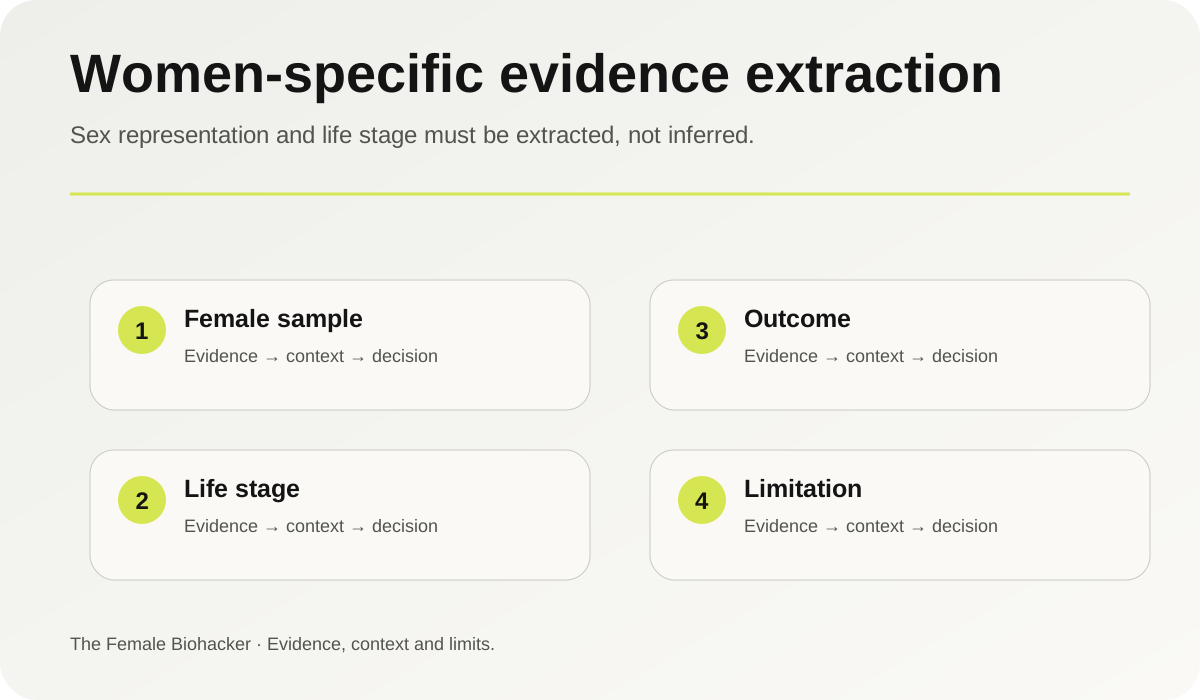
Extraction method
Define before reading
Record design, sample, age or life stage, intervention, comparator, outcome and follow-up.
Report only what is visible
Do not infer menopausal status, sex-specific effects or subgroup results from silence.
Preserve missingness
“Not reported” remains a result because it limits applicability.
Inclusion and exclusion
Included: records already used in the site’s women-specific claim set with explicit female, perimenopause, menopause or postmenopause relevance visible in the linked abstract/record. Excluded: inaccessible subgroup details, unreported menopause status, seller summaries and mechanistic extrapolation presented as an outcome.
Update: expand only under a predefined protocol; recheck source records quarterly or when a correction/new review changes an interpretation.
Dataset limit
This is a six-record editorial evidence map, not a systematic review, meta-analysis, clinical guideline or original human-subject study. The six selected records are not a complete inventory of women’s health research, and selection can leave important studies out.
How representation becomes an applicability judgment
Count enrollment
Record sex distribution, age, menopause stage and health/training status where reported.
Check analysis
Inclusion is not a subgroup answer: determine whether women or life stages were analyzed with adequate power.
Preserve the gap
Mark unreported fields as unreported; do not infer them from a study title, mean age or recruitment setting.
Update rules
Reopen the primary record when a correction, protocol, full text or new trial changes population or outcome interpretation. Add records only under the same inclusion criteria, record the date, and retain prior snapshots so a changing evidence base is visible rather than silently rewritten.
The map is an editorial dataset assembled from public studies. It is not a new clinical study, individual-participant analysis or claim that representation alone establishes benefit.
Life-stage background
STRAW+10 supplies reproductive-aging terminology; it does not validate this editorial sample or the other papers. Each row links to its own record. The map is a reading aid, not a treatment recommendation.
- Executive summary of the Stages of Reproductive Aging Workshop + 10: addressing the unfinished agenda of staging reproductive aging., 2012 Apr. PMID 22341880. Checked 2026-08-25.