On this page
Direct answer
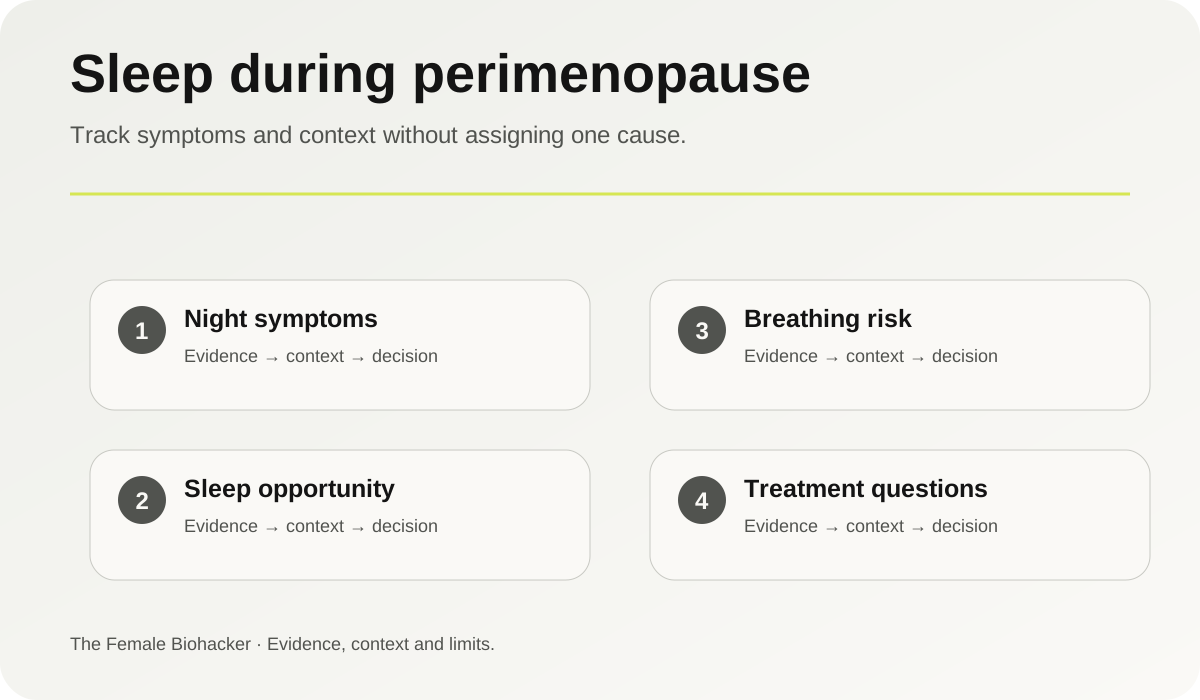
Sleep problems can become more common during the menopause transition.1 Hot flashes and night sweats may wake some people, while anxiety, depression, pain, sleep apnea, restless legs, medications, alcohol, caregiving, and circadian disruption can contribute independently.1 The pattern matters because treatment should match the cause.2
Consistent wake timing, adequate sleep opportunity, a dark and comfortable environment, and behavioral treatment for chronic insomnia are evidence-based foundations.3 “Sleep hygiene” alone may be insufficient for persistent insomnia, and sedating supplements are not automatically safe.1 Loud snoring, gasping, marked daytime sleepiness, or persistent insomnia deserves assessment.
Key takeaways
- Sleep disruption is common but not always caused by hot flashes.1
- Chronic insomnia has specific behavioral treatments beyond generic tips.
- Sleep apnea can occur in women and may present as fatigue or insomnia.1
- Alcohol and sedating products can worsen sleep quality or safety.1
How strong is the evidence?
Evidence supports behavioral interventions for menopause-related sleep disturbance, although studies differ in symptoms and treatment formats.34 The links among reproductive hormones, vasomotor symptoms, and sleep are plausible and observed, but individual causation is complex.1
Strong Human Evidence
Why women-specific context matters
Women’s sleep apnea may be under-recognized when symptoms are labeled as fatigue, mood, or menopause.4 Night work, caregiving, pain, pregnancy history, body size, medications, and socioeconomic constraints shape sleep opportunity and treatment feasibility.1
What we know
- Night sweats can fragment sleep.1
- Cognitive behavioral therapy for insomnia is an established non-drug approach for chronic insomnia.3
- Sleep apnea and restless legs require condition-specific evaluation.1
What we do not know yet
- Consumer sleep-stage estimates are not equivalent to polysomnography.1
- No supplement reliably solves all perimenopause sleep problems.13
- A high or low wearable score does not identify the cause of symptoms.4
Practical, non-prescriptive next steps
- Anchor a realistic wake time and protect sufficient sleep opportunity.1
- Note awakenings, hot flashes, snoring, alcohol, caffeine timing, medicines, and daytime sleepiness.
- Use a cool, dark, quiet environment when possible and reduce clock-watching during awakenings.
- Ask about structured insomnia treatment or sleep-disorder evaluation when symptoms persist.1
Risks, limits and important context
- Drowsy driving is a safety issue; do not rely on stimulants to compensate.
- Sedating antihistamines, alcohol, cannabis, and supplements can impair coordination or interact with medicines.2
- Sleep restriction protocols should be individualized when bipolar disorder, seizure disorders, fall risk, or marked sleepiness is present.1
- Snoring is not harmless when paired with gasping or daytime impairment.
Common myths
“Everyone needs exactly eight hours.”
Sleep need varies; function, consistency, and adequate opportunity matter.1
“Sleep hygiene cures chronic insomnia.”
Helpful habits are foundational, but persistent insomnia may need a structured treatment.1
“Wearables measure sleep stages precisely.”
Consumer devices estimate sleep and can be useful for patterns, but they are not diagnostic tests.1
When to seek professional care
- Seek evaluation for persistent insomnia, loud snoring or gasping, restless legs, severe daytime sleepiness, or mood deterioration.
- Urgent care is warranted for severe breathing difficulty, chest pain, or acute neurologic symptoms.4
- If you cannot stay safe because of a mental-health crisis, contact 988 or emergency services.2
References
- National Institute on Aging. Sleep Problems and Menopause: What Can I Do?. Accessed 2026-08-21.
- Systematic review. Menopause hormones and sleep (PMID 36356400). Accessed 2026-08-21.
- Review. Behavioral interventions for menopausal sleep disturbance (PMID 36067398). Accessed 2026-08-21.
- Office on Women’s Health. Menopause symptoms and relief. Accessed 2026-08-21.
Related reading
Claim-level source ledger
Evidence used on this page
- The role of ovarian hormones in the pathophysiology of perimenopausal sleep disturbances: A systematic review – PubMed. PMID 36356400. DOI 10.1016/j.smrv.2022.101710. Checked 2026-08-25.
- www.nia.nih.gov. Checked 2026-08-25.
- Behavioral interventions for improving sleep outcomes in menopausal women: a systematic review and meta-analysis – PubMed. PMID 36067398. DOI 10.1097/GME.0000000000002051. Checked 2026-08-25.
- Menopause symptoms and relief | Office on Women’s Health. Checked 2026-08-25.
Interpretation boundary: each source is listed for the statement it supports; population and design limits remain visible.