On this page
Direct answer
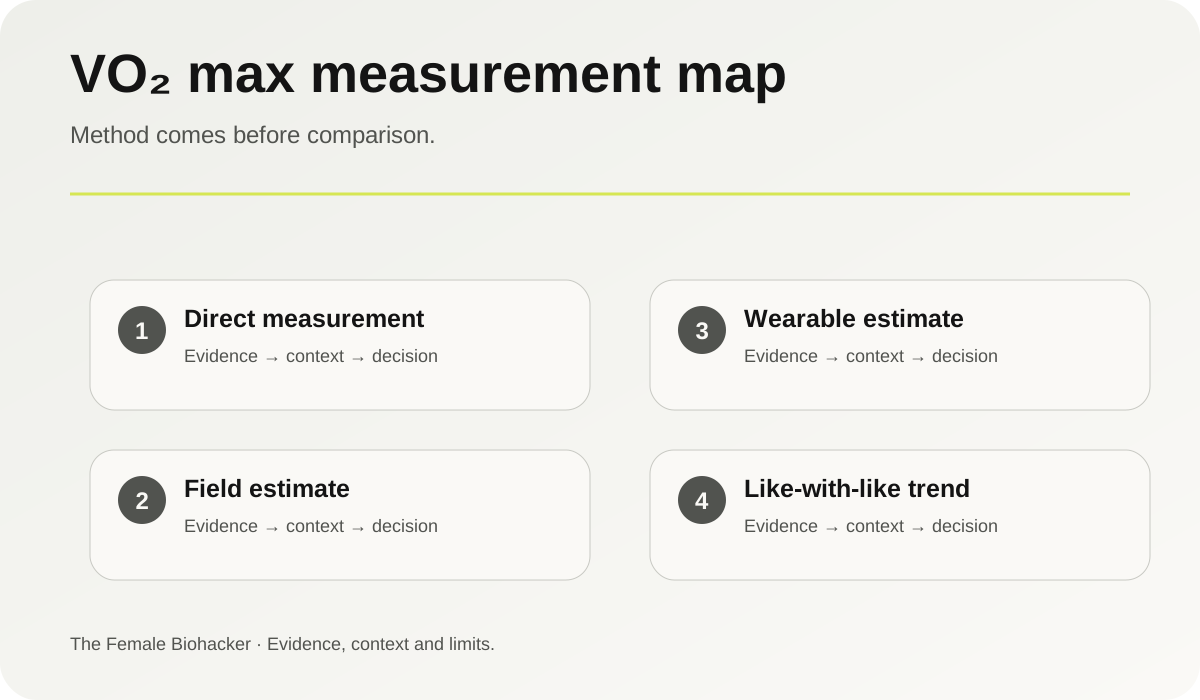
VO₂ max is the highest rate at which the body can use oxygen during progressively harder exercise, commonly expressed relative to body mass.1 A cardiopulmonary exercise test with gas analysis measures it directly; field tests and wearables estimate it using algorithms and assumptions. Results from different methods are not automatically interchangeable.
Age- and sex-specific reference data can provide population context only when the protocol, units, and population match.1 Cardiorespiratory fitness is strongly associated with health outcomes at the population level, but a single score cannot diagnose disease, predict an individual lifespan, or provide medical clearance.2
Key takeaways
- Identify whether the value was directly measured or estimated.
- Compare only with a compatible dataset and units.
- Trend under similar conditions can be more useful than one isolated score.1
- Symptoms and clinical risk override a consumer fitness category.3
How strong is the evidence?
Large registries provide useful normative reference equations, and meta-analyses link cardiorespiratory fitness with lower mortality risk.32 These are population relationships. Device validation, calibration, test protocol, and selection bias affect individual interpretation.
Strong Human Evidence
Why women-specific context matters
Female reference values are important, but binary categories do not represent every body or identity. Pregnancy, menopause, anemia, medications, altitude, disability, and body-composition scaling can affect interpretation.1 Research samples may not reflect all U.S. populations.1
What we know
- Direct gas-exchange testing is the reference method for measuring peak oxygen uptake.
- Wearables and field tests estimate rather than directly measure.
- Regular aerobic training can improve cardiorespiratory fitness, although response varies.32
What we do not know yet
- A consumer score cannot reveal why a value is low or changing.1
- “Fitness age” is not a standardized medical diagnosis.3
- Universal percentile cutoffs do not apply across protocols, devices, and populations.
Practical, non-prescriptive next steps
- Record the device or protocol, units, date, and testing conditions.
- Repeat using the same method under broadly similar conditions before interpreting a trend.
- Use gradual aerobic training plus strength and recovery rather than chasing one score.3
- Discuss symptoms, an unexpected drop, or medical risk with a qualified clinician or exercise professional.3
Risks, limits and important context
- Do not perform maximal testing without appropriate screening and supervision when medical risk is present.3
- Stop exercise for chest pain, fainting, severe breathlessness, or new neurologic symptoms.2
- Altitude, illness, medication, heat, and device fit can affect results.1
- The value does not diagnose heart, lung, blood, or metabolic disease.3
Common myths
“A low score proves disease.”
It can have many explanations and needs clinical context; a category is not a diagnosis.2
“Wearables measure VO₂ max directly.”
Most infer it from heart rate, pace, power, and proprietary modeling.
“One number defines longevity.”
Fitness is important, but health outcomes reflect many factors and population associations do not predict one person.2
When to seek professional care
- Seek assessment for chest symptoms, fainting, unexplained severe breathlessness, palpitations with symptoms, or a major unexplained decline.
- Use clinical testing when a diagnostic or medical decision is required.
- Call emergency services for acute chest pain, collapse, or stroke-like symptoms.1
References
- FRIEND registry. Reference standards for cardiorespiratory fitness (PMID 28377168). Accessed 2026-08-21.
- Meta-analysis. Cardiorespiratory fitness and mortality outcomes (PMID 35562197). Accessed 2026-08-21.
- Meta-analysis. Cardiorespiratory fitness comparisons (PMID 39271056). Accessed 2026-08-21.
- U.S. Department of Health and Human Services. Physical Activity Guidelines for Americans. Accessed 2026-08-21.
Related reading
- Use the method-aware interpreter
- Workout framework
- Strength alongside aerobic fitness
- Evidence method
Claim-level source ledger
Evidence used on this page
- A Reference Equation for Normal Standards for VO₂ Max: Analysis from the FRIEND Registry. PMID 28377168. Checked 2026-08-25.
- Comparison of objectively measured and estimated cardiorespiratory fitness to predict all-cause and cardiovascular disease mortality in adults: A systematic review and meta-analysis of 42 studies representing 35 cohorts and 3.8 million observations – PubMed. PMID 39271056. DOI 10.1016/j.jshs.2024.100986. Checked 2026-08-25.
- Objectively Assessed Cardiorespiratory Fitness and All-Cause Mortality Risk: An Updated Meta-analysis of 37 Cohort Studies Involving 2,258,029 Participants – PubMed. PMID 35562197. DOI 10.1016/j.mayocp.2022.02.029. Checked 2026-08-25.
Interpretation boundary: each source is listed for the statement it supports; population and design limits remain visible.