On this page
- Regulatory status first
- Evidence category map
- Who this is for
- What the evidence can support
- What remains uncertain
- Verification steps
- Risks, red flags, and limits
- Sources
- Evidence and status are separate questions
- Evidence used on this page
- Continue the evidence path
- FDA status snapshot — 22 August 2026
- Four categories that should never be collapsed
FDA-Approved, Compounded, Investigational, or Research-Market Peptides
A status-first guide to terms that are often blurred in peptide marketing.12
Regulatory status first
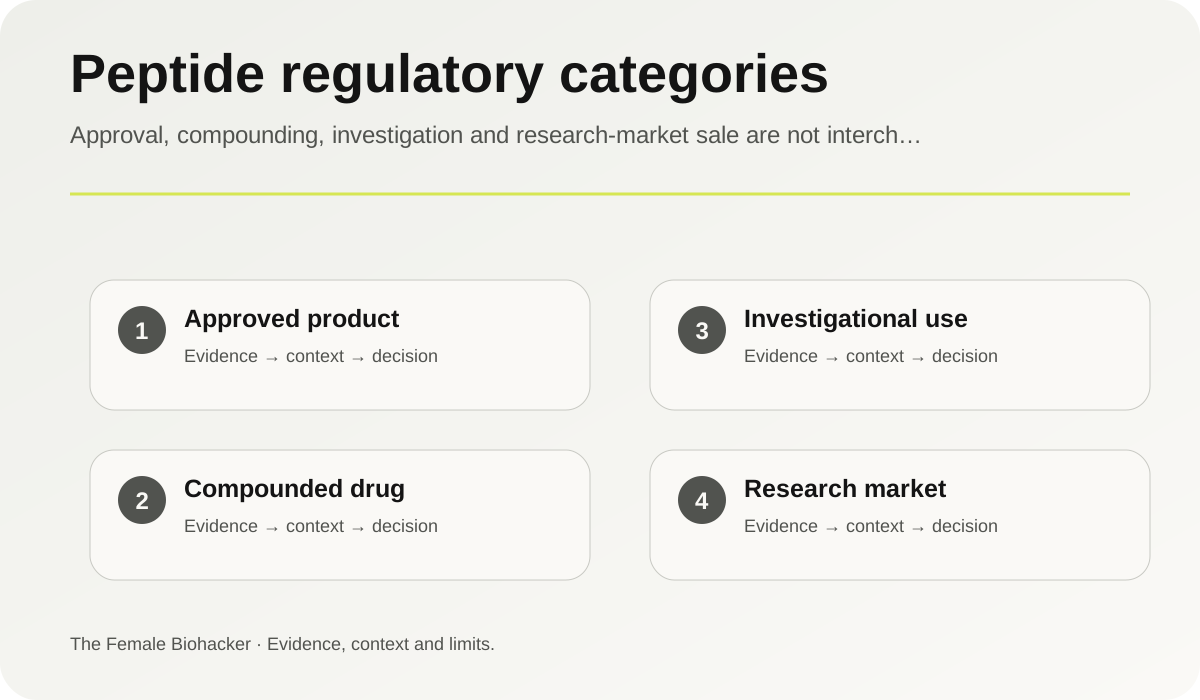
Regulatory categories are not interchangeable. Approval attaches to a specific drug product and labeled use; compounding, clinical investigation, and research-market sale operate under different rules and evidence standards.1
Evidence category map
Who this is for
Women navigating midlife health decisions and the clinicians or reviewers helping them evaluate evidence and uncertainty.
What the evidence can support
- Drugs@FDA identifies approved drug products and current labels.12
- ClinicalTrials.gov can show registered research but not prove success.1
- FDA warning letters and compounding pages document enforcement and safety concerns.12
What remains uncertain
- Regulatory status can change and must be checked near publication.12
- Marketing language may omit route- or formulation-specific distinctions.1
- State pharmacy rules and federal law can interact.1
Verification steps
- Record exact product, active ingredient, formulation, route, and claimed use.
- Verify approval in Drugs@FDA rather than relying on a seller.
- Check current FDA sources for the exact product and intended use.
Risks, red flags, and limits
- Never infer approval from a facility, ingredient, patent, trial, or COA.1
- This page is educational and not legal advice.
- Do not use it to source unapproved drugs.
Sources
Evidence and status are separate questions
| Layer | Question | Common category error |
|---|---|---|
| Product status | Is the exact product approved, compounded, investigational or sold for research? | Treating a facility, ingredient or trial as product approval |
| Human evidence | Do trials match the molecule, route, population and claimed outcome? | Generalizing from animals, another peptide or another route |
| Quality | What identity, batch, sterility and endotoxin evidence exists? | Using analytical purity as a synonym for sterile or safe |
| Personal decision | What established alternatives, risks and monitoring questions matter? | Letting an online claim replace qualified care |
This publication provides no dose, cycle, injection technique, seller ranking or procurement path for unapproved investigational products.12
Claim-level source ledger
Evidence used on this page
- Certain Bulk Drug Substances for Use in Compounding that May Present Significant Safety Risks | FDA. Checked 2026-08-25.
- Internal Error (). Checked 2026-08-25.
Interpretation boundary: each source is listed for the statement it supports; population and design limits remain visible.
FDA status snapshot — 22 August 2026
This table records the current FDA compounding-risk page, not a legal conclusion or complete adverse-event review.12
| Substance | FDA page observation | Publication boundary |
|---|---|---|
| BPC-157 | Limited safety information; immunogenicity, impurity and API-characterization concerns described. | No human benefit or safety claim. |
| CJC-1295 | Limited clinical data; serious adverse events described. | No sourcing or dosing. |
| Ipamorelin | Safety concerns and insufficient proposed-route information described. | No standalone or combination endorsement. |
| GHK-Cu for injection | Limited human safety data described. | Do not generalize from topical cosmetics. |
| MOTS-c | No human exposure data identified on the page. | Preclinical interest only. |
| TB-500 fragment | No human exposure data identified on the page. | Do not generalize from broader thymosin literature. |
Update rule: check the linked Drugs@FDA record and FDA safety-risk page for the current status. This dated snapshot is not a live monitoring service.
Four categories that should never be collapsed
| Category | What it establishes | What it does not establish |
|---|---|---|
| FDA-approved drug | A specific product, indication, labeling and manufacturing review | Approval of every compounded version, off-label claim or chemical relative |
| Compounded drug | A patient-specific or outsourcing-facility pathway may apply under federal and state rules | FDA premarket approval, equivalence to an approved drug or blanket safety |
| Investigational product | Study under a defined protocol may be registered or authorized | General sale, proven benefit or routine clinical use |
| Research-market product | A seller is labeling an item outside ordinary human-drug presentation | Identity, sterility, lawful self-use, clinical evidence or medical suitability |
Verify an exact product in Drugs@FDA, examine the precise compounding context in FDA’s compounding resources, and treat trial registration as a research record—not approval.