On this page
- Regulatory status first
- Evidence category map
- Who this is for
- What the evidence can support
- What remains uncertain
- Verification steps
- Risks, red flags, and limits
- Sources
- Evidence and status are separate questions
- Evidence used on this page
- Continue the evidence path
- Status first: a three-part triage
- Continue with market and label literacy
- Where uncertainty enters the chain
Peptide Safety: What the Label Does Not Tell You
A regulatory- and evidence-aware framework for separating approved medicines from compounded, investigational, and research-market products.12
Regulatory status first
“Peptide” describes a broad chemical class, not a single safety category.1 Safety depends on the specific substance, formulation, route, manufacturing controls, clinical evidence, and regulatory status.12
Evidence category map
- An FDA-approved peptide medicine has product-specific evidence and labeling; that does not validate other peptides.12
- Compounded drugs are not FDA approved and are not reviewed by FDA for safety, effectiveness, or quality before marketing.12
- A research-use-only label does not establish suitability for human use.1
Who this is for
Women navigating midlife health decisions and the clinicians or reviewers helping them evaluate evidence and uncertainty.
What the evidence can support
- Product-specific FDA labeling can establish approved uses and known risks.12
- Human trials may inform a defined population, dose, route, and endpoint.1
- Identity, purity, sterility, endotoxin control, storage, and handling are separate quality questions.1
What remains uncertain
- Many marketed peptides lack adequate human exposure data.
- Online product claims may not match composition or regulatory status.12
- Female- and menopause-specific evidence is often absent or indirect.1
Verification steps
- Identify the exact active ingredient and route.
- Check Drugs@FDA for approved products and labeling.
- Ask what evidence applies to women like you and what remains unknown.
Risks, red flags, and limits
- Do not inject a product sold for research use.
- A certificate of analysis is not proof of sterility, appropriate manufacturing, or clinical suitability.1
- Urgent symptoms after any product require appropriate medical care.
Sources
Evidence and status are separate questions
| Layer | Question | Common category error |
|---|---|---|
| Product status | Is the exact product approved, compounded, investigational or sold for research? | Treating a facility, ingredient or trial as product approval |
| Human evidence | Do trials match the molecule, route, population and claimed outcome? | Generalizing from animals, another peptide or another route |
| Quality | What identity, batch, sterility and endotoxin evidence exists? | Using analytical purity as a synonym for sterile or safe |
| Personal decision | What established alternatives, risks and monitoring questions matter? | Letting an online claim replace qualified care |
This publication provides no dose, cycle, injection technique, seller ranking or procurement path for unapproved investigational products.12
Claim-level source ledger
Evidence used on this page
- Certain Bulk Drug Substances for Use in Compounding that May Present Significant Safety Risks | FDA. Checked 2026-08-25.
- Drugs@FDA: FDA-Approved Drugs. Checked 2026-08-25.
Interpretation boundary: each source is listed for the statement it supports; population and design limits remain visible.
Status first: a three-part triage
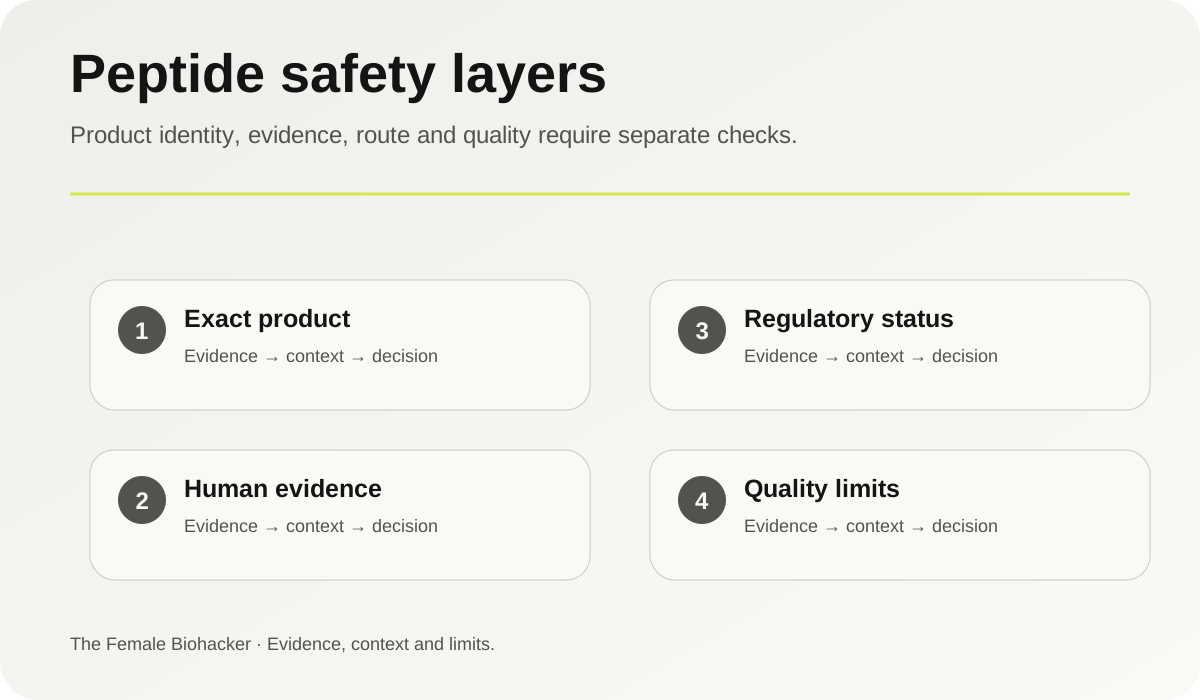
Begin with the exact product and route, then check approval or compounding status, then examine human evidence for the claimed outcome.1 A favorable answer in one column cannot repair a failure in another: an interesting trial does not authenticate a vial, and analytical purity does not establish clinical benefit.1
Continue with market and label literacy
Where uncertainty enters the chain
| Layer | Question that must be answered | What cannot answer it |
|---|---|---|
| Molecule | Is relevant human safety and benefit evidence available for this exact substance? | Animal healing mechanisms or another peptide in the same category |
| Product | Who made the product, under what legal category and controls? | A facility number, “pharmaceutical grade” wording or a vial photo |
| Batch | Do identity, content, contamination, sterility and endotoxin records match this lot? | A purity percentage alone or a report without traceable batch fields |
| Use | Are route, indication, interactions and monitoring supported? | Influencer protocols, seller testimonials or research-use labeling |
A single reassuring answer does not repair uncertainty at the other layers.1 When an exact product is unapproved and human safety information is inadequate, the responsible conclusion is uncertainty—not an improvised protocol.